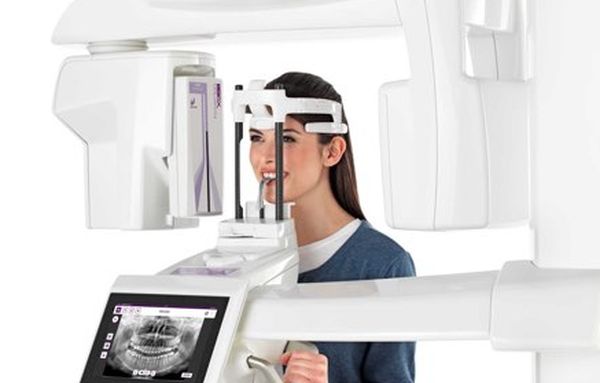
3D CT – more precisely, cone beam CT (CBCT) – has quietly become one of the most important diagnostic tools in modern dentistry, especially in implant and complex restorative care. At a clinic like Platinum Dental Budapest, this technology underpins the accuracy, safety and predictability of treatment for UK and Irish patients travelling to Hungary for advanced work.
What 3D CT / CBCT actually is
3D dental CT, usually CBCT, is a specialised scan that captures hundreds of low-dose X‑ray images around the head and reconstructs them into a three‑dimensional model of the teeth, jaws and surrounding structures. Unlike the flat picture from a panoramic X‑ray, CBCT lets the dentist view your anatomy from any angle and slice, revealing details that 2D images simply cannot show.
This three‑dimensional view covers teeth, bone, nerve canals, sinuses and sometimes even parts of the airway, helping the team understand both hard and some soft tissues in one scan. For patients, the experience is quick and painless: you stand or sit still for around 20–30 seconds while the machine rotates around your head.
Why 3D CT matters for diagnosis
The core value of CBCT is diagnostic accuracy. Small infections, fractures or anatomical variations that are hidden or unclear on standard X‑rays often become obvious when viewed in 3D.
Some key diagnostic advantages:
-
Hidden infections at root tips or between roots can be detected more reliably, improving root canal decisions and retreatment planning.
-
Vertical root fractures, which are notoriously difficult to see on 2D films, may be identified more clearly, avoiding unnecessary, repeated procedures.
-
Complex tooth positions, impacted canines and wisdom teeth close to nerves or sinuses can be mapped in detail, reducing surgical surprises.
For a clinic that handles a high volume of advanced restorative and implant cases, this level of detail is fundamental to planning treatment that works in the real anatomy, not just on paper.
Planning dental implants with 3D CT
Implant dentistry is one of the main areas where CBCT has completely changed standards of care. Instead of estimating bone height and width from two‑dimensional images, the dentist can measure real bone volume in all three dimensions and see exactly where nerves and sinus cavities lie.
With high-quality CBCT and planning software:
-
Bone quality and density can be assessed to judge how well an implant is likely to integrate.
-
The ideal implant length, diameter and angulation can be chosen based on real measurements, not guesswork.
-
Vital structures such as the inferior alveolar nerve and maxillary sinus are clearly mapped, reducing the risk of nerve injury or sinus perforation.
-
Surgical guides can be fabricated that fit over your teeth or gums and direct the drill to the pre‑planned position, making “guided surgery” more precise and minimally invasive.
For UK and Irish patients flying to Budapest for full arch work, this pre‑planning is crucial: it shortens surgery time, reduces intra‑operative improvisation and supports more predictable outcomes in fewer visits.
Role in root canal and restorative treatment
3D CT is not only about implants. In endodontics (root canal therapy), CBCT offers a clearer view of the internal anatomy and surrounding bone.
It can help to:
-
Reveal additional root canals that are missed on 2D films, a common cause of root canal failure.
-
Show the full extent and exact location of periapical lesions (infections around root tips), informing whether to treat, retreat or consider surgery.
-
Evaluate complex resorption defects, cracks or unusual root shapes that affect prognosis and choice of treatment.
In broader restorative planning, CBCT can support assessment of tooth position, crown‑root ratios and bone support, which is particularly helpful in full‑mouth reconstructions where mechanical load and long‑term stability are critical.
3D CT in wisdom teeth and surgical dentistry
When it comes to impacted wisdom teeth, 3D CT can dramatically improve safety and predictability.
A CBCT scan can show:
-
The exact path and shape of the roots.
-
How close those roots are to the mandibular nerve, which carries sensation to the lower lip and chin.
-
The relationship of upper wisdom teeth to the maxillary sinus and adjacent teeth.
This information helps the surgeon choose the safest surgical approach, anticipate potential complications and discuss realistic risk with the patient. For clinics performing many extractions on international patients, this extra layer of planning helps reduce unexpected nerve symptoms or sinus issues after you have already flown home.
Radiation dose and safety considerations
Radiation is a legitimate concern for many patients, and any honest review of 3D CT must address it. CBCT uses more radiation than a single small dental X‑ray, but usually significantly less than a full medical CT of the same area.
Key safety points:
-
Typical CBCT effective doses are lower than conventional medical CT scans and are considered safe when used judiciously.
-
The lifetime cancer risk from a single dental CBCT scan is estimated to be very low – often cited as below 10 per million scans.
-
Modern machines and low‑dose protocols further reduce exposure, and radiation remains within widely accepted safety margins for diagnostic imaging.
Clinics are expected to follow justification and optimisation principles: a 3D scan is only taken when it clearly changes diagnosis or treatment planning and is performed with the lowest dose that still provides adequate image quality.
What Platinum Dental Budapest offers with 3D CT
Platinum Dental Budapest is one of the Hungarian clinics that has integrated CBCT into routine advanced diagnostics for international patients. According to independent descriptions of their technology, they use CBCT 3D scanning specifically for pre‑surgical implant planning, mapping nerve paths and bone density in three dimensions.
Practical benefits for UK and Irish visitors include:
-
Access to modern CBCT imaging on‑site, avoiding the need to attend external radiology centres once you arrive.
-
The option to share scans digitally with your home dentist if follow‑up care or coordination is needed after you return.
-
Transparent, published pricing for 3D CT scans in Budapest, which is generally lower than typical UK private imaging fees, yet uses contemporary equipment.
For patients combining multiple procedures – for example, extractions, grafting and immediate or delayed implants – having CBCT and planning in the same centre adds convenience and continuity of care.
Patient experience: what the scan is like
For most people, a 3D dental CT scan is one of the easiest parts of treatment.
You can expect:
-
To remove metal items such as earrings, glasses or removable dentures so they do not distort the image.
-
To stand or sit in the CBCT unit while your head is gently stabilised.
-
The machine rotates around your head for roughly half a minute, during which you must keep still and usually bite lightly on a small support.
-
No pain, no injections and no sensation from the X‑rays themselves.
Afterwards, the images are processed and can be reviewed with you on‑screen, often with 3D models and cross‑sections that help you understand your own anatomy and proposed treatment.
Advantages for UK / Irish dental tourists
Travelling for dental care adds layers of logistical and psychological stress. 3D CT supports more predictable, compact treatment schedules – a major advantage if you are flying in from the UK or Ireland.
Benefits include:
-
Fewer surprises during surgery, which means less chance of abandoned procedures or unplanned extra visits.
-
The ability to plan full arch or complex implant cases digitally before a surgical visit, sometimes using scans taken in your home country and shared with the Budapest team.
-
Better communication: 3D images make it easier to explain why a graft, sinus lift or staged approach is recommended in your specific case.
-
Easier coordination with your local dentist for long‑term maintenance, because scans and reports can be exported and stored digitally.
For many patients, seeing a 3D model of their jaws is also reassuring: it demonstrates that the clinic is not working “blind” but basing decisions on detailed, personalised data.
Limitations and when 3D CT is not needed
Despite its advantages, CBCT is not necessary or appropriate for every dental issue. Over‑use would expose patients to unnecessary radiation and cost.
Limitations include:
-
Higher dose than basic digital intraoral radiographs, so CBCT is usually reserved for cases where 2D imaging cannot answer essential questions.
-
Reduced image clarity in the presence of metal restorations or movement, which can produce artefacts and require careful interpretation.
-
Limited soft tissue contrast compared with full medical CT or MRI, so it is not a replacement for medical scans when broader pathology is suspected.
Good practice means your dentist should be able to explain clearly why a 3D scan is recommended in your case and how it will directly influence treatment choices.
How 3D CT supports long‑term outcomes
The value of CBCT is not only in getting through surgery safely; it also touches long‑term success.
For implants:
-
Better positioning in adequate bone reduces the risk of early failure and improves load distribution under chewing forces.
-
More accurate angulation makes restoring implants with crowns or bridges easier, often avoiding excessively angled abutments or compromises in aesthetics.
For root canal and complex restorative:
-
Thorough diagnosis of cracks, hidden canals and surrounding bone changes can inform whether a tooth is truly salvageable or better replaced.
-
Early detection of pathology reduces the chance of chronic, undiagnosed problems persisting behind seemingly sound restorations.
For surgical extractions:
-
Detailed mapping of roots and nearby structures reduces trauma and the likelihood of complications that can affect long‑term comfort and nerve function.
Clinics that use CBCT as a standard tool for complex cases tend to have more predictable planning, which supports both short‑ and long‑term success.
Is 3D CT right for your case?
If you are considering treatment at Platinum Dental Budapest or a similar clinic, it is reasonable to ask whether a 3D CT scan will be part of your assessment and why.
It is particularly worth discussing CBCT if:
-
You are planning dental implants, especially multiple implants or a full arch restoration.
-
You have had repeated root canal problems, unexplained pain or suspected cracks.
-
Your wisdom teeth or other impacted teeth are close to nerves or sinuses.
-
You have been told your bone is “thin” or “complex” and grafting may be required.
When justified and carried out with modern, low‑dose equipment by trained staff, 3D CT in dentistry is a powerful ally: it gives your dentist a clearer map, reduces guesswork and helps you make informed decisions about complex treatment far from home.