For many, a missing tooth is often viewed as a purely cosmetic inconvenience—a gap in a smile that we might try to hide behind a hand or by tilting our head during photos. However, as any dental professional will tell you, the space left behind by a lost tooth is a ticking clock for your oral health.
In the UK, recent data from the Adult Oral Health Survey suggests that while we are keeping our natural teeth longer than previous generations, a significant portion of the population still struggles with tooth loss due to decay, gum disease, or trauma. If you are sitting with a gap in your smile, you aren’t just losing a chewing surface; you are losing bone density, facial structure, and potentially your confidence.
This guide explores why missing teeth are more dangerous than they look, how you can prevent further loss, and the modern pathways to a full smile—including the increasingly popular world of international dental tourism.
Why “Just One Missing Tooth” Is Never Just One Problem
The mouth is a finely balanced ecosystem. When one piece of the puzzle is removed, the entire structure begins to shift. Here is the reality of what happens when a tooth is not replaced:
1. The Domino Effect (Teeth Shifting)
Teeth rely on their neighbours to stay in position. When a gap appears, the teeth on either side no longer have a “border” to keep them upright. They begin to tilt and lean into the empty space. Furthermore, the tooth directly above or below the gap (the opposing tooth) may start to “supra-erupt”—effectively growing out of its socket because there is no biting pressure to hold it in place. This leads to a misaligned bite, which can cause jaw pain and further tooth loss.
2. Jawbone Atrophy
Your jawbone stays healthy and dense through the stimulation it receives from chewing. The roots of your teeth transmit force into the bone, signalling it to regenerate. The moment a tooth is lost, that stimulation ceases. The body begins to resorb the bone in that area because it deems it “unnecessary.” Within the first year of losing a tooth, you can lose up to 25% of the bone width in that specific area.
3. Facial Collapse and Premature Ageing
Your teeth and jawbone provide the internal framework for your face. When bone loss becomes extensive across several missing teeth, the distance between the chin and the nose decreases. This causes the cheeks to hollow out and the skin around the mouth to pucker, leading to what is often called “premature facial ageing” or a sunken appearance.
4. Nutritional and Digestive Issues
Efficient digestion begins in the mouth. If you cannot chew properly, you tend to avoid fibrous, nutrient-dense foods like raw vegetables, nuts, and tough proteins. Many people with missing teeth default to a “soft food” diet, which is often higher in carbohydrates and lower in essential vitamins, impacting overall systemic health.
Prevention: Keeping the Teeth You Have
While modern replacements are incredible, nothing beats your natural dentition. Preventing tooth loss in 2026 revolves around three pillars: hygiene, habit, and intervention.
-
The 2:2 Rule: It sounds basic, but brushing for two minutes, twice a day with fluoride toothpaste remains the gold standard. In 2026, many UK patients are switching to “smart” electric toothbrushes that use AI to track coverage, ensuring no areas are missed.
-
Interdental Cleaning: If you aren’t flossing or using interdental brushes, you are leaving 35% of your tooth surfaces uncleaned. This is where gum disease—the leading cause of adult tooth loss—begins.
-
Sugar Management: It isn’t just the amount of sugar; it’s the frequency. Constant “acid attacks” from snacking on sugary foods prevent your enamel from remineralising.
-
Night Guards: Many people lose teeth to “bruxism” (teeth grinding). Stress-related grinding is on the rise in the UK, and a custom-fitted night guard can prevent the fractures that lead to extractions.
The Modern Menu: Options for Replacing Teeth
If you have already lost a tooth, the good news is that 2026 offers more sophisticated options than ever before.
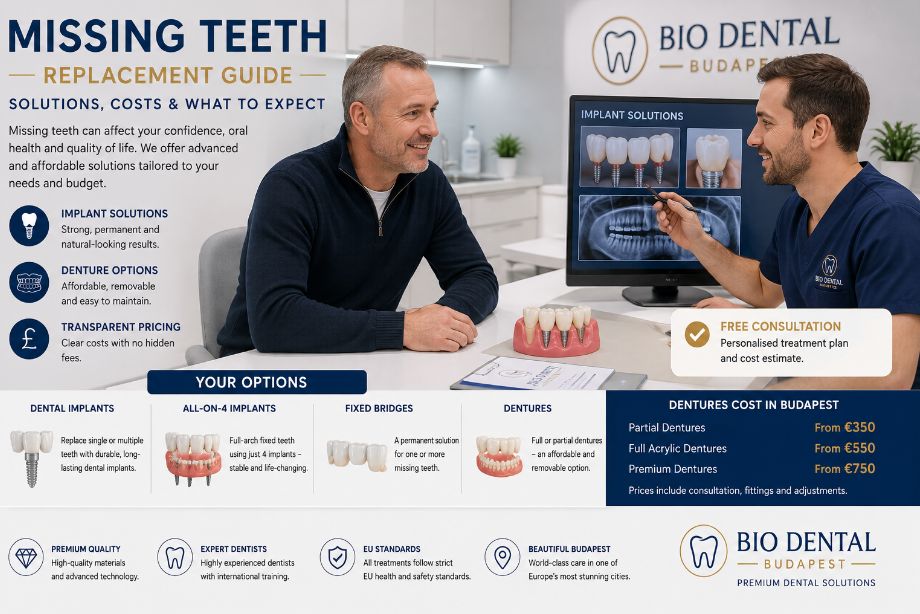
1. Dental Implants (The Gold Standard)
A dental implant is essentially a titanium or ceramic screw that acts as an artificial tooth root. It is surgically placed into the jawbone, where it fuses with the bone in a process called osseointegration.
-
Pros: Prevents bone loss, feels like a natural tooth, can last a lifetime.
-
Cons: Higher initial cost, requires minor surgery.
2. All-on-4 / All-on-6 (Full Arch Restoration)
For those missing all or most of their teeth, the “All-on-X” technique is a game-changer. Instead of an implant for every single tooth, a full bridge of 12–14 teeth is supported by just four or six strategically placed implants called All-on-4 system.
-
Best For: Patients with significant bone loss who want to move away from removable dentures.
3. Fixed Dental Bridges
A bridge “bridges” the gap by using the healthy teeth on either side as anchors. These anchors are fitted with crowns, and a false tooth (pontic) is suspended between them.
-
Pros: Non-surgical, faster than implants.
-
Cons: Requires the “shaving down” of healthy adjacent teeth; does not prevent bone loss in the gap.
4. Modern Dentures
Forget the “false teeth in a glass” image. Modern dentures use high-grade acrylics and even flexible polymers to provide a better fit and more natural look. However, they remain a removable solution and do not stop jawbone resorption.
The Rise of Dental Tourism: Should You Travel for Your Smile?
With private dental costs in the UK for a single implant often ranging between £2,000 and £3,500, many Brits are looking across the Channel and beyond. Dental tourism is no longer a “back-alley” gamble; it is a sophisticated, multi-billion pound industry.
Top Destinations for UK Patients in 2026
| Country | Estimated Cost (Single Implant) | Estimated Cost (All-on-4) | Why Go There? |
| Turkey | £400 – £800 | £3,500 – £6,000 | Massive infrastructure, luxury “all-inclusive” packages. |
| Hungary | £600 – £1,000 | £4,500 – £7,500 | Longest history of dental tourism in Europe; high academic standards. |
| Poland | £500 – £900 | £4,000 – £7,000 | Strict EU regulations and exceptional technical skill. |
| Albania | £350 – £700 | £3,000 – £5,500 | The “rising star” with the lowest prices in Europe for 2026. |
The Expert Review: Is It Worth It?
As a dental tourism expert, my review of the “abroad” option is nuanced. You can save up to 70% on UK prices, even when factoring in flights and hotels. However, the “uniqueness” of a successful dental trip lies in the preparation, not just the price.
The Benefits:
-
Speed: Clinics abroad are often geared toward “express” treatments, completing work in 5–7 days that might take months in the UK.
-
Technology: Because they cater to international patients, top-tier clinics in Istanbul or Budapest often house more advanced 3D imaging (CBCT) and in-house CAD/CAM labs than your local UK high-street dentist.
The Risks to Manage:
-
Aftercare: If an implant fails six months later, flying back to Turkey for a “free” fix still costs you a plane ticket and time off work.
-
Communication: Ensure the clinic provides a dedicated English-speaking coordinator.
-
Material Transparency: Always ask for the “Implant Passport.” You want brands like Straumann, Nobel Biocare, or Osstem. These are global brands; if a component breaks, a UK dentist can actually find the parts to fix it.
Conclusion: Don’t Leave the Gap Unfilled
Missing teeth are a progressive problem. What starts as a small gap today can lead to a collapsed face and thousands of pounds in corrective surgery a decade from now.
Whether you choose a private clinic in London or a state-of-the-art facility in Budapest, the most important step is the first one: consultation. In 2026, the technology exists to give anyone a functional, beautiful smile regardless of their starting point. Your health, your ability to eat what you love, and your willingness to smile without hesitation are worth the investment.