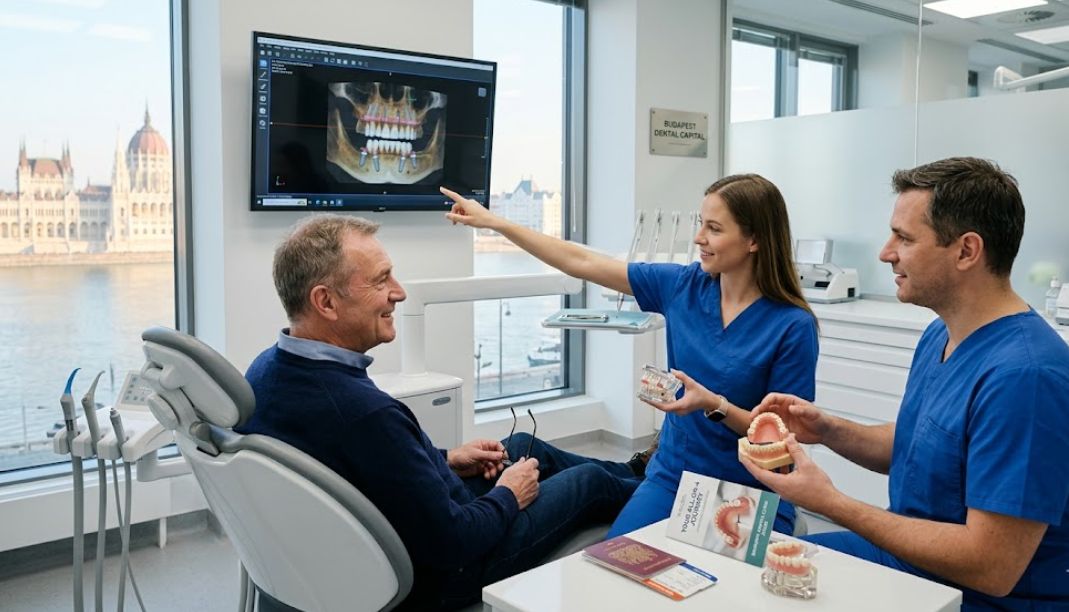
For over two decades, Budapest has been affectionately dubbed the “Dental Capital of Europe.” For patients in the UK facing the daunting prospect of high-cost private dentistry or endless NHS waiting lists, the Hungarian capital remains the premier destination for complex restorative work.
In 2026, the landscape of dental tourism has evolved. It is no longer just about finding the lowest price; it is about accessing world-class technology, ultra-specialised surgeons, and seamless patient care that often outpaces local high-street options. If you are considering single implants, All-on-4, or complex bone grafting, this expert review breaks down exactly what to expect from a Budapest dental journey.
Single Tooth vs. Multiple Replacements: Choosing Your Foundation
The most common reason patients travel to Budapest is to replace one or more missing teeth with dental implants. Unlike bridges, which rely on neighbouring teeth for support, an implant is a standalone solution that preserves your natural jawbone.
Single Tooth Implants
A single implant consists of three parts: the titanium screw (the root), the abutment (the connector), and the crown (the visible tooth).
-
The Budapest Advantage: Leading clinics use premium brands like Nobel Biocare, Straumann, and AlphaBio. While a single implant in the UK can easily exceed £2,500, top clinics in Budapest offer the same premium hardware for between £600 and £950.
-
Timeline: Typically requires two trips. The first trip (2–3 days) involves the surgical placement of the implant. After a healing period of 3–6 months, you return for the final crown fitting (5–7 days).
Multiple Tooth Replacements
If you are missing three or four teeth in a row, you may not need an implant for every single gap. An implant-supported bridge can use two implants to support a three or four-unit bridge, significantly reducing the overall cost while providing a rock-solid biting surface.
Full Arch Restoration: All-on-4 vs. All-on-6
For patients with failing teeth or those currently struggling with loose dentures, full-arch restoration is life-changing. Budapest clinics are global leaders in these “Teeth in a Day” protocols.
The All-on-4 System
This technique uses four strategically placed implants to support a full bridge of 12–14 teeth. The two rear implants are tilted at a 30-to-45-degree angle.
-
Why it’s popular: The tilting often allows the surgeon to avoid the sinuses (in the upper jaw) or nerve canals (in the lower jaw), frequently eliminating the need for expensive and time-consuming bone grafts.
-
Temporary Teeth: Most Budapest clinics provide an immediate “fixed” temporary bridge within 24 hours of surgery, meaning you never leave the clinic without a smile.
The All-on-6 System
When bone volume is sufficient, many Budapest surgeons recommend six implants.
-
The Benefit: Six implants provide a more even distribution of chewing force across the jawbone. It offers a “mechanical safety margin”—if one implant fails over twenty years, the remaining five can often still support the bridge.
-
Suitability: This is typically recommended for younger patients with high bite forces or those who have a history of grinding their teeth (bruxism).
Complex Prep: Bone Grafts and Sinus Lifts
Many UK patients are told by their local dentists that they “don’t have enough bone” for implants. In Budapest, this is rarely a dead end. Hungarian oral surgeons are renowned for their expertise in reconstructive jaw surgery.
-
Bone Grafting: This involves adding synthetic or bovine bone material to the site to increase width or height. It can often be done simultaneously with the implant placement.
-
Sinus Lifts: In the upper jaw, the sinus cavity is often too close to the gum line. A “lift” involves gently pushing the sinus membrane upward and inserting bone material underneath to create a solid foundation for the implant.
-
Cost Comparison: A sinus lift in London can cost £1,500–£2,500. In Budapest, it typically ranges from £400 to £650, making complex cases financially viable.
Beyond Removable: The Evolution of Dentures
While traditional dentures are still available, the 2026 trend in Budapest is Implant-Retained Dentures (often called “Snap-on Dentures”).
-
How they work: Using 2 to 4 mini-implants, the denture “clicks” into place. It doesn’t move while you speak or eat, but you can still remove it for cleaning.
-
Who it’s for: Patients who want the stability of implants but are on a stricter budget than a fixed All-on-4 bridge would allow.
Temporary Teeth: The “Same Day” Promise
One of the biggest anxieties for dental tourists is being “toothless” during the healing phase. Modern Budapest clinics have solved this with high-quality temporary prosthetics.
Whether you are getting a single crown or a full arch, you will be fitted with a temporary solution. These are usually made from high-grade PMMA (acrylic) and are designed to look natural and protect the surgical site while the bone integrates with the titanium.
Navigating Your Journey: What to Look for in 2026
When choosing a clinic in Budapest, look for these three pillars of quality:
-
The Implant Passport: Ensure the clinic provides a document detailing the brand, model, and serial number of your implants. This ensures any dentist in the world can service them in the future.
-
In-House CAD/CAM Labs: The best clinics have their own digital laboratories. This allows for “while-you-wait” adjustments and ensures the highest level of precision in the fit of your crowns and bridges.
-
Comprehensive Guarantees: Reputable Budapest clinics offer a 5-year to lifetime guarantee on implant hardware and 2–3 years on laboratory work (crowns/bridges).
The Financial Reality
By travelling to Budapest, UK patients typically save 50% to 70% on their total treatment plan, even when including flights and stays in one of Europe’s most beautiful historic cities.
| Procedure | Average UK Price | Average Budapest Price |
| Single Implant + Crown | £2,500 – £3,500 | £650 – £950 |
| All-on-4 (Full Arch) | £12,000 – £18,000 | £4,500 – £6,500 |
| Sinus Lift | £1,500 – £2,500 | £400 – £600 |
Final Review Verdict
Budapest remains the gold standard for dental tourism for a reason. The combination of EU-regulated safety standards, significantly lower overheads, and a long-standing tradition of dental excellence makes it a logical choice for anyone facing significant restorative costs.
Are you ready to trade your dental anxiety for a consultation in the heart of Hungary? Whether it’s a single tooth or a full-arch transformation, the path to a new smile is more accessible than you think.